Pizza Shock \ noun.
1. : a psychological state induced when consuming differently tasting pizza from another region (originally coined for New Yorkers, New York pizza); culture shock, for pizza
2. : "pizza delivered so fast, it shocks you!"
Movies. Stuff. Etc.

All writings by Jeff Catapang.
Cold Pizza:
- 23.03.03
- 30.03.03
- 13.04.03
- 20.04.03
- 27.04.03
- 11.05.03
- 09.11.03
- 23.11.03
- 04.04.04
- 06.06.04
- 25.07.04
- 23.01.05
- 06.02.05
- 13.02.05
- 20.02.05
- 06.03.05
- 01.05.05
- 02.10.05
- 09.10.05
- 14.05.06
- 21.05.06
![[Powered by Blogger]](http://buttons.blogger.com/bloggerbutton1.gif)


May 01, 2003
posted
by Scene -- @ 3:12 PM
Crossing Over ‘8 Mile’
 When Jimmy “B Rabbit” Smith Jr. (Eminem) walks out of the Shelter after losing a rap battle, his friend Future (Mekhi Phifer) offers him words of comfort, calling Rabbit his “nigga”. At the end of the movie, after Rabbit has overcome his stage fright and defeated local champion Poppa Doc (Anthony Mackie), Future congratulates Rabbit by calling him “The Man”.
Thus, in a nutshell, is the sub-textual story of the movie. Eminem plays a young, white rapper who strives to both earn respect in the Detroit hip-hop scene and clean up his home-life problems — cheating girlfriends, shady friends, a trashy mom and her trashier boyfriend, and a little sister, Lily (Chloe Greenfield), whom Rabbit tries to protect from the reality of her upbringing. Naturally, he succeeds, and the surface-message of the film is no doubt inspiring: “Believe in Yourself; Prove Them Wrong”. But as Future and his changing terms of endearment show us, the film itself depicts a white man who goes from seeking to be accepted by blacks in a black sub-culture, only to then use the skills he’s learned to rise above the blacks who have accepted him -- from Nigga to Man.
From the start of the movie, Rabbit is portrayed as more passionate and more talented than the rest of his black friends. Future is a fellow-emcee, but he constantly defers to Rabbit’s skill. While Poppa Doc and the rest of his Leaders of the Free World crew reign supreme as Detroit’s finest un-signed rappers, they spend the film flashing ice grills, beating up others, brandishing guns, intimidating Rabbit and his crew, and generally just wandering about thugging. Rabbit, on the other hand is shown writing rhymes on the bus on the way to work on tiny pieces of scrap paper, writing by dim desk lamp at night when he should be sleeping, freestyling to “Sweet Home Alabama” while fixing his car, constantly honing his craft. To Rabbit, rap is an obsessive passion. To the Leaders of the Free World, rap is just another way to intimidate and assert their authority.
 Of course, Rabbit is 8 Mile’s Rocky Balboa, so naturally we would have this version of the running-up-the-steps sequence. The difference is, while Rocky’s road to greatness involved getting over the speed bump of his own mediocrity and lack of motivation, Rabbit’s speed bump is posited as one of racism. Rabbit’s struggle is not only to prove he is the best, but to prove he is the best despite the fact that he is only a white-boy from a trailer park on the wrong (read: white) side of 8 Mile Road.
The film’s final battle plays a dangerous game with words. Battling Poppa Doc for the title, Rabbit is chosen to go first. While going first can often mean defeat in rap battles—it gives your opponent material to flip on you—Rabbit wins by openly admitting everything he knows Poppa Doc will accuse him of: Yes, he’s white, he’s trailer trash, his friends are burn-outs, the Free World beat him up, and his girlfriend cheated on him. After this confessional, however, Rabbit then turns to outing Doc as a private school boy whose real name is Clarence, mocking him because his parents had “a real nice marriage”. And by admitting his own struggles and then accusing Doc of not having any, Rabbit essentially proves himself to be “realer” (read: blacker) than the current, actually black, champion.
 Poppa Doc and the Free World aren’t the only casualties. With one line during his final cathartic freestyle, Rabbit rhymes “Yes, my friend Future is an Uncle Tom”. And while certainly humorous and effective towards his goal of stripping Poppa Doc of battle material, the line shows that both Rabbit and the film are aware of racial relations and dangerous racial stereotypes. If Future is an Uncle Tom simply for befriending and supporting the white Rabbit (for this reviewer sees no other way how the comparison can be warranted), then that makes Rabbit the Massa. And if he and the film are not aware of it, they should be. His comment may be meant as tongue-in-cheek, but the implications of such a statement prove salty.
In the final scene of the film, after Future has entitled Rabbit “The Man”, Future asks his buddy if he’d like to team up, host some shows together, and help build up his name in the community. Rabbit declines, and tells his friend that he wants to “do his own thing”. In this exchange Future is do doubt left looking like the lesser of the two. Rabbit, if his Uncle Tom comment was indeed a joke, does not apologize for it.
The final frame is of Rabbit walking away from his friends into the mist of the distance, just as the cowboys of Western yore, as Future and the rest call out to him. Now his own man, Rabbit does not look back. Having proven himself in a black man’s world and earning the “realness” that such a feat offers, Rabbit is now free to carve his own path, untied by the racial restraints his black friends no doubt still have to deal with.
 The film doesn’t seem to be aware of what Eminem in real life is: a talented white rapper will become successful both because he is talented and white, not because he is talented in spite of his whiteness.
And to be sure, this is not a movie about hip-hop (though the whole rap scene is portrayed with respect and style by director, Curtis Hanson). Which is sad, because hip-hop has many more interesting tales to offer. Tales —- even that of Eminem’s in real life (for, despite their obvious similarities, 8 Mile’s story is not the same as Eminem’s) -— that speak more volumes on racism than Rabbit’s tale ever could. For when the story of a person’s journey from “nigga” to “Man” is the story of a white person, you know there’s something shady going on.
Jef.Catapang
Crossing Over ‘8 Mile’
When Jimmy “B Rabbit” Smith Jr. (Eminem) walks out of the Shelter after losing a rap battle, his friend Future (Mekhi Phifer) offers him words of comfort, calling Rabbit his “nigga”. At the end of the movie, after Rabbit has overcome his stage fright and defeated local champion Poppa Doc (Anthony Mackie), Future congratulates Rabbit by calling him “The Man”.
Thus, in a nutshell, is the sub-textual story of the movie. Eminem plays a young, white rapper who strives to both earn respect in the Detroit hip-hop scene and clean up his home-life problems — cheating girlfriends, shady friends, a trashy mom and her trashier boyfriend, and a little sister, Lily (Chloe Greenfield), whom Rabbit tries to protect from the reality of her upbringing. Naturally, he succeeds, and the surface-message of the film is no doubt inspiring: “Believe in Yourself; Prove Them Wrong”. But as Future and his changing terms of endearment show us, the film itself depicts a white man who goes from seeking to be accepted by blacks in a black sub-culture, only to then use the skills he’s learned to rise above the blacks who have accepted him -- from Nigga to Man.
From the start of the movie, Rabbit is portrayed as more passionate and more talented than the rest of his black friends. Future is a fellow-emcee, but he constantly defers to Rabbit’s skill. While Poppa Doc and the rest of his Leaders of the Free World crew reign supreme as Detroit’s finest un-signed rappers, they spend the film flashing ice grills, beating up others, brandishing guns, intimidating Rabbit and his crew, and generally just wandering about thugging. Rabbit, on the other hand is shown writing rhymes on the bus on the way to work on tiny pieces of scrap paper, writing by dim desk lamp at night when he should be sleeping, freestyling to “Sweet Home Alabama” while fixing his car, constantly honing his craft. To Rabbit, rap is an obsessive passion. To the Leaders of the Free World, rap is just another way to intimidate and assert their authority.
Of course, Rabbit is 8 Mile’s Rocky Balboa, so naturally we would have this version of the running-up-the-steps sequence. The difference is, while Rocky’s road to greatness involved getting over the speed bump of his own mediocrity and lack of motivation, Rabbit’s speed bump is posited as one of racism. Rabbit’s struggle is not only to prove he is the best, but to prove he is the best despite the fact that he is only a white-boy from a trailer park on the wrong (read: white) side of 8 Mile Road.
The film’s final battle plays a dangerous game with words. Battling Poppa Doc for the title, Rabbit is chosen to go first. While going first can often mean defeat in rap battles—it gives your opponent material to flip on you—Rabbit wins by openly admitting everything he knows Poppa Doc will accuse him of: Yes, he’s white, he’s trailer trash, his friends are burn-outs, the Free World beat him up, and his girlfriend cheated on him. After this confessional, however, Rabbit then turns to outing Doc as a private school boy whose real name is Clarence, mocking him because his parents had “a real nice marriage”. And by admitting his own struggles and then accusing Doc of not having any, Rabbit essentially proves himself to be “realer” (read: blacker) than the current, actually black, champion.
Poppa Doc and the Free World aren’t the only casualties. With one line during his final cathartic freestyle, Rabbit rhymes “Yes, my friend Future is an Uncle Tom”. And while certainly humorous and effective towards his goal of stripping Poppa Doc of battle material, the line shows that both Rabbit and the film are aware of racial relations and dangerous racial stereotypes. If Future is an Uncle Tom simply for befriending and supporting the white Rabbit (for this reviewer sees no other way how the comparison can be warranted), then that makes Rabbit the Massa. And if he and the film are not aware of it, they should be. His comment may be meant as tongue-in-cheek, but the implications of such a statement prove salty.
In the final scene of the film, after Future has entitled Rabbit “The Man”, Future asks his buddy if he’d like to team up, host some shows together, and help build up his name in the community. Rabbit declines, and tells his friend that he wants to “do his own thing”. In this exchange Future is do doubt left looking like the lesser of the two. Rabbit, if his Uncle Tom comment was indeed a joke, does not apologize for it.
The final frame is of Rabbit walking away from his friends into the mist of the distance, just as the cowboys of Western yore, as Future and the rest call out to him. Now his own man, Rabbit does not look back. Having proven himself in a black man’s world and earning the “realness” that such a feat offers, Rabbit is now free to carve his own path, untied by the racial restraints his black friends no doubt still have to deal with.
The film doesn’t seem to be aware of what Eminem in real life is: a talented white rapper will become successful both because he is talented and white, not because he is talented in spite of his whiteness.
And to be sure, this is not a movie about hip-hop (though the whole rap scene is portrayed with respect and style by director, Curtis Hanson). Which is sad, because hip-hop has many more interesting tales to offer. Tales —- even that of Eminem’s in real life (for, despite their obvious similarities, 8 Mile’s story is not the same as Eminem’s) -— that speak more volumes on racism than Rabbit’s tale ever could. For when the story of a person’s journey from “nigga” to “Man” is the story of a white person, you know there’s something shady going on.
Jef.Catapang
April 28, 2003
posted
by Scene -- @ 9:52 PM
THE GOOD AND BAD IN ‘DAREDEVIL’
(originally published in York University's Excalibur, Volume 37, issue 24, February 26, 2002)
 If it had been directed by John Woo in his prime, Daredevil could have been one kick-ass movie. All of Woo’s favorite themes and motifs are present in the movie as directed by Mark Steven Johnson and starring Ben Affleck: the hero/villain identity crisis, the religious imagery, the sacrilegious showdown in a church, the motif of sight, and lots of ballet-like battle scenes.
Unfortunately, a lesser talent helms the movie. Writer/director Johnson gets points for enthusiasm and loyalty—you can tell he is having fun and actually cares about these characters.
Several moments in the film are pitch perfect: when villain Bullseye (Colin Ferrel) makes his first significant kill, causing Elektra (Jennifer Garner) to turn on Daredevil and fire off a round of ammunition at the hero while Bullseye grins and escapes. Moments of wonderful staging and minimalist acting gestures like these makes one wonder why other parts of the movie overrun with cheese and excess.
Johnson visually brings out themes of blind justice, sight and seeing, and the balance of good/evil and God/Devil in several moments of the film. Some are done well, such as Dardevil in his Satanic costume perched atop a church monument, bleeding. Others are done horribly, such as the film’s cheesiest scene in which a blind Daredevil battles Elektra on a playground’s seesaw—oh the scales of justice, and how they sway!
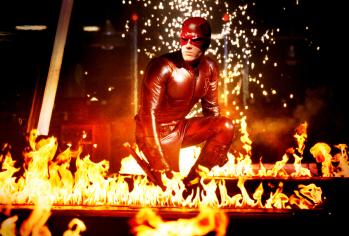 To his credit, Johnson does a good job of staging probably the most-highly anticipated battle scene (at least where comic book nerds are concerned), the battle between Bullseye and Elektra. Later, his staging of Daredevil vs. Bullseye proves equally riveting despite blatantly ripping off The Matrix and Spiderman.
Johnson’s scales of quality swing low again at the final showdown between Daredevil and Kingpin (Michael Clarke Duncan), not only because the movie doesn’t develop Kingpin - thus we don’t care about him - but also because his fighting prowess is highly unbelievable and because he utters the movie’s worst line (an incredible feat, let me assure you): “I was raised in the Bronx! You wouldn’t understand…”
Ferrel remains the movie’s best feature — a deliciously hammy yet frightening villain, who’s dependence on sight sets up a nice thematic dichotomy with Daredevil’s blindness.
In the end, however, one wonders if director Johnson is more Bullseye than Daredevil — did his radar sense warn him that his movie was fatally flawed, or like Bullseye, did he fall victim to delusions that he couldn’t miss? Like Bullseye in the movie, nonetheless, Johnson hits some and misses some.
And in the end, the misses prove to be his and the movie’s undoing.
-J.
THE GOOD AND BAD IN ‘DAREDEVIL’
(originally published in York University's Excalibur, Volume 37, issue 24, February 26, 2002)
If it had been directed by John Woo in his prime, Daredevil could have been one kick-ass movie. All of Woo’s favorite themes and motifs are present in the movie as directed by Mark Steven Johnson and starring Ben Affleck: the hero/villain identity crisis, the religious imagery, the sacrilegious showdown in a church, the motif of sight, and lots of ballet-like battle scenes.
Unfortunately, a lesser talent helms the movie. Writer/director Johnson gets points for enthusiasm and loyalty—you can tell he is having fun and actually cares about these characters.
Several moments in the film are pitch perfect: when villain Bullseye (Colin Ferrel) makes his first significant kill, causing Elektra (Jennifer Garner) to turn on Daredevil and fire off a round of ammunition at the hero while Bullseye grins and escapes. Moments of wonderful staging and minimalist acting gestures like these makes one wonder why other parts of the movie overrun with cheese and excess.
Johnson visually brings out themes of blind justice, sight and seeing, and the balance of good/evil and God/Devil in several moments of the film. Some are done well, such as Dardevil in his Satanic costume perched atop a church monument, bleeding. Others are done horribly, such as the film’s cheesiest scene in which a blind Daredevil battles Elektra on a playground’s seesaw—oh the scales of justice, and how they sway!
To his credit, Johnson does a good job of staging probably the most-highly anticipated battle scene (at least where comic book nerds are concerned), the battle between Bullseye and Elektra. Later, his staging of Daredevil vs. Bullseye proves equally riveting despite blatantly ripping off The Matrix and Spiderman.
Johnson’s scales of quality swing low again at the final showdown between Daredevil and Kingpin (Michael Clarke Duncan), not only because the movie doesn’t develop Kingpin - thus we don’t care about him - but also because his fighting prowess is highly unbelievable and because he utters the movie’s worst line (an incredible feat, let me assure you): “I was raised in the Bronx! You wouldn’t understand…”
Ferrel remains the movie’s best feature — a deliciously hammy yet frightening villain, who’s dependence on sight sets up a nice thematic dichotomy with Daredevil’s blindness.
In the end, however, one wonders if director Johnson is more Bullseye than Daredevil — did his radar sense warn him that his movie was fatally flawed, or like Bullseye, did he fall victim to delusions that he couldn’t miss? Like Bullseye in the movie, nonetheless, Johnson hits some and misses some.
And in the end, the misses prove to be his and the movie’s undoing.
-J.